

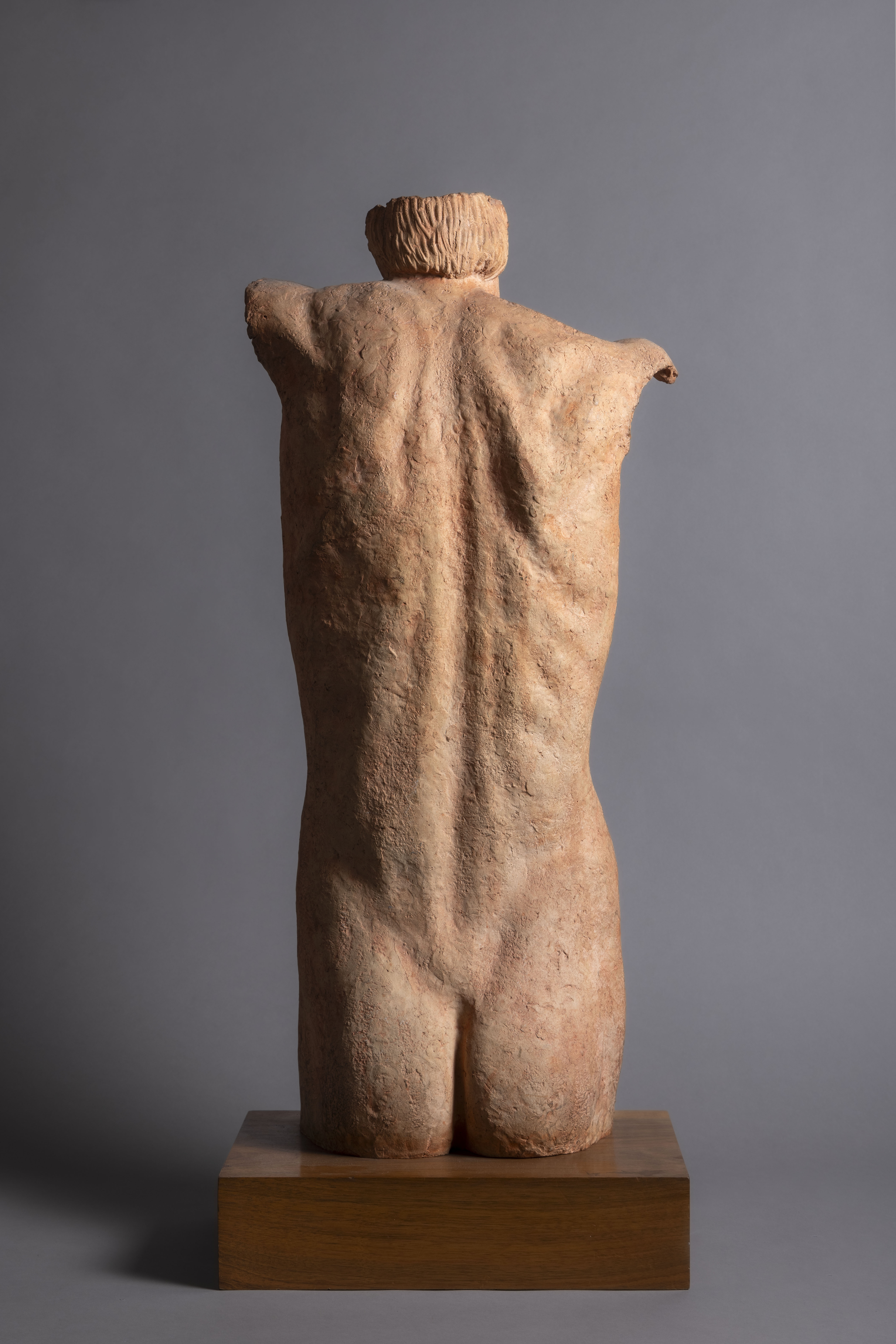
Created in the 1920s, the Torso of a Young Man is one of the most brilliant examples of Arturo Martini's mastery of terracotta, a material favored by the artist for its vibrant immediacy. The work depicts an adolescent male torso, armless and broken at the pelvis. This is not a forced mutilation, but a synthetic choice that focuses all attention on the tension of the flesh and the purity of the lines. The surface, intentionally unpolished, retains a porous and warm texture that captures the light, lending the sculpture an almost pulsating vitality. In this work, Martini admirably blends archetypal classicism—reminiscent of Etruscan statuary and Renaissance grace—with a thoroughly modern and restless sensibility. The modeling alternates solid volumes with subtle asymmetries, evoking a pure, melancholic, and timeless beauty. The torso thus becomes an absolute fragment, an icon of youth suspended between stillness and life.
Home, Classic, ground. Picasso, Léger, De Chirico, and the new classicism 1910–1930, Londra, Tate Gallery, 1990 Arturo Martini, Firenze, Palazzo Medici Riccardi, 1991; Italian Art from Simbolism to Scuola Romana: the artist of Anticoli Corrado, Londra, 1996–1997; Roma, 1918–1943, Roma, Chiostro del Bramante, 1998; Novecento Arte e Storia in Italia, Roma, Scuderie papali al Quirinale, 2000–2001; Keramos, ceramica nell’arte italiana 1910–2000, Roma, Museo del Corso, 2003; Arturo Martini, Fondazione Stelline Milano/GAM Roma, 2006–2007.
